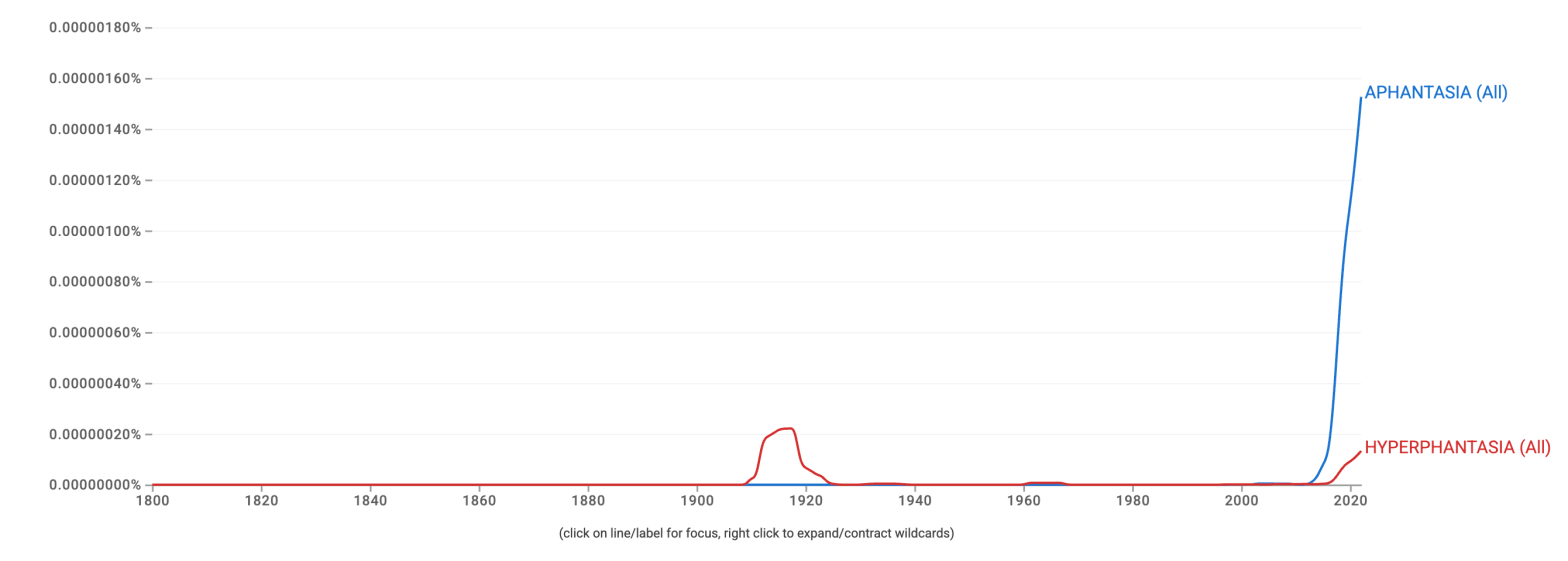
Researchers of visual mental imagery tend to ignore mental imagery research prior to the year 2010 – with a few notable exceptions: Galton (1880) , Kosslyn, Thompson and Ganis (2006), and Marks (1973). This overlooking of past studies means that findings, concepts and hypotheses that make up the discipline’s knowledge base are unprocessed by contemporary researchers. This can lead to an embarrassing situation in which people credit “discoveries” that are previously made findings regurgitated as originals. Old wine in new bottles.
The term “hyperphantasia” is one fairly recent example. The term first appeared in clinical literature exactly 100 years prior to the term “aphantasia” (Zeman et al., 2015). The term was used in 1915 in The American Journal of Insanity (the precursor to the American Journal of Psychiatry), specifically in Volume 71, Issue 4.
The Original Citation (1915)
The term appears in a book review or clinical abstract section, often associated with the work of European psychologists or psychiatrists being translated or reviewed for American audiences.
Citation: The American Journal of Insanity (1915). Vol 71, Issue 4. Utica State Hospital Press.
The Etymological Origin: Dr. Bernard Onuf (Onufrowicz)
Historical evidence points toward Dr. Bernard Onuf (also known as Onufrowicz), a neurologist who worked at the Craig Colony for Epileptics and later in New York. Onuf used “hyperphantasia” to describe an excessive or pathological vividness of the imagination—a state where the internal “phantasia” was so strong it began to overlap with hallucinations or manic ideation.
The 100-Year Gap
For most of the 20th century, the term fell into disuse as psychology shifted toward Behaviorism, which largely ignored “mental imagery” because it could not be observed from the outside.
-
1915: “Hyperphantasia” is used to describe “over-active” or “morbid” mental imagery in psychiatric patients.
-
1972/73: David Marks introduced the VVIQ and used the descriptive term “vivid visualizers” for high-vividness subjects and “poor visualizers” for low-vividness subjects. These terms and the accompanying research findings have been “cancelled”. This author’s 1972 and 1973 publications reported significant differences in picture recall ability between extreme groups of vivid- and non-vivid visualizers which validated the VVIQ group differences for the first time. The research community uses the VVIQ but mainly overlooks the finding that validated the VVIQ against an objective measure of picture memory. Contemporary researchers continue to seek an objective correlate of VVIQ scores
- 2015: J. Alison Catoptrica
-
Studies in the Literary Imagination, 2015 – muse.jhu.edu…hyperphantasia: “when mind-pictures burn so brightly they light other synapses, and the figment becomes fully sensed?”
-
2015: Adam Zeman revived the term “Hyperphantasia” 100 years after its original appearance, apparently unaware that the term already existed.
The 100-year gap includes “amnesia” for many other interesting findings and concepts that do not yet exist for many mental imagery scholars. One awaits more “discoveries” in the mental imagery research locker.
Leave a Reply