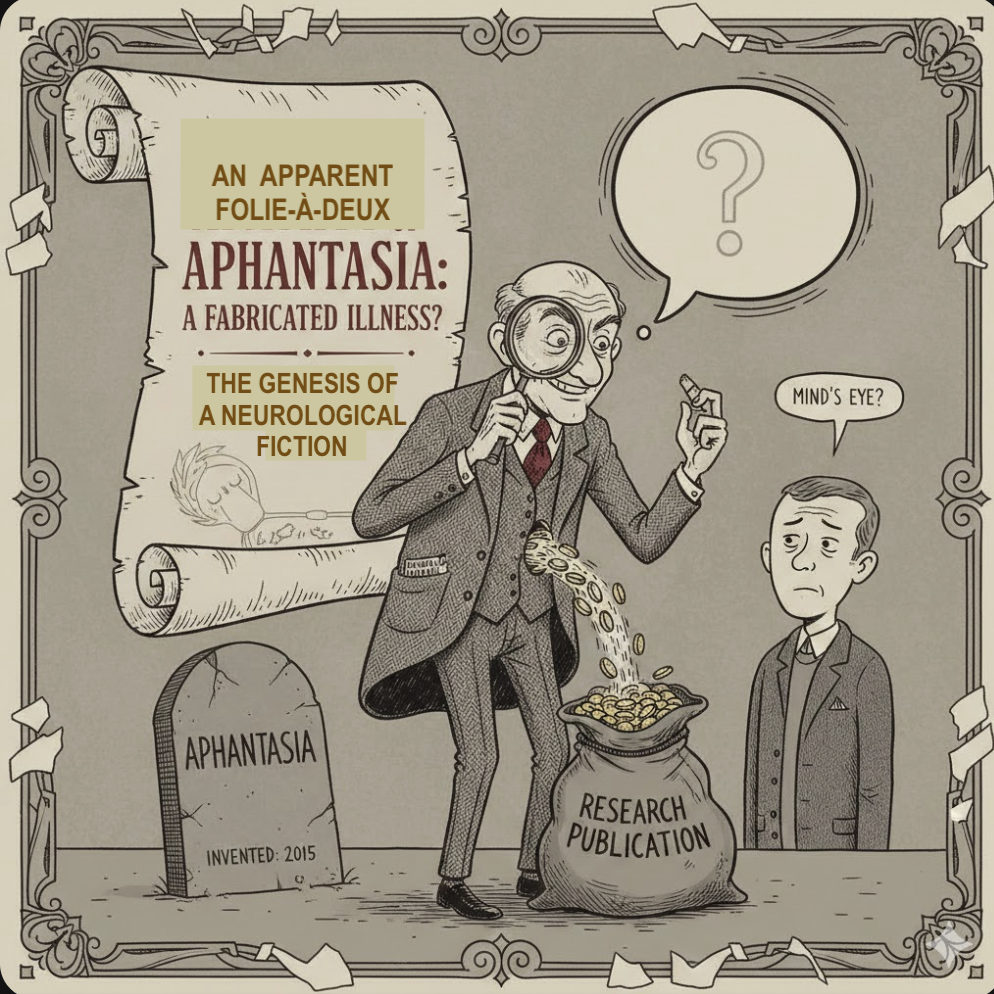
A previous post issued a warning for VVIQ users. It invites VVIQ and VVIQ-2 test users to treat low-VVIQ-scores with care. Statistically normal scores are being misinterpreted by professionals, journalists and the public. The subjects of this misinterpretation are being labelled with a new category of disorder. There is a growing trend to label low-VVIQ-scoring individuals as “aphantasics” and high-VVIQ- scoring individuals as “hyperphantasics”. The warning recently added to the VVIQ and VVIQ-2, states:
“Warning
Neither the original 16-item VVIQ nor the extended version, VVIQ-2, are intended to be used as a screening tool for clinical/neurological conditions. Any score including the minimum and maximum is a measure of an individual difference in a distribution. To assume otherwise would be an illegitimate abuse of this instrument.”
In the journal Cortex, Andrea Blomkvist and I questioned whether “aphantasia” should be defined and ‘diagnosed’ as a condition or should AP be considered an individual difference? This issue is crucial and will not go away any time soon; if anything, it is will become ever more prominent.
Here I argue that “aphantasia” (AP) is a label that is highly vulnerable to misuse. As a consequence of its increasingly prevalent misuse, especially for the safety of the public, it is this author’s view that the AP term should be retired. And swiftly: please may the term be retired before it becomes reified like so many labels for faux disorders and conditions beloved by Big Pharma, psychiatrists and few other healthcare professionals, and appreciated much less by patients and caregivers. As a label, AP has many fewer ‘pros’ than ‘cons’, which I outline next. I confine the discussion here to the medical ethics from the viewpoint of the AP-labelled subjects.
‘Cons’
- The term “aphantasia” is a label for an alleged disorder, with a foundation in neurology, the science of disorders of the nervous system. The author of the term is Professor Adam Zeman of Exeter University. Quoting Prof. Zeman’s website, https://experts.exeter.ac.uk/1385-adam-zeman (14/12/25) we see that:
“Prof. Zeman trained in Medicine at Oxford University Medical School, after a first degree in Philosophy and Psychology, and later in Neurology in Oxford, at The National Hospital for Neurology in Queen Square, London and Addenbrooke’s Hospital, Cambridge. He [is] Professor of Cognitive and Behavioural Neurology. His specialised clinical work is in cognitive and behavioural neurology, including neurological disorders of sleep. His main research interests are disorders of visual imagery and forms of amnesia occurring in epilepsy…. From 2007-2010 he was Chairman of the British Neuropsychiatry Association. He launched and continues to direct its training course in neuropsychiatry. Zeman is a member of the Centre for Clinical Neuropsychology Research. Qualifications: BMBCh MA DM FRCP”
So, there we have it: as one of Prof. Zeman’s main research interests, aphantasia (not mentioned by name) is a “disorder of visual imagery”. In one fell swoop, Zeman and colleagues have anointed 1% of the human population – around 83 million – with a new neurological disorder they didn’t know they had. If the more extravagant estimate of AP prevalence is correct – 4% of the population – that would make 330 million neurological cases, enough to keeping neurologists busy forever.
- Aphantasia is the latest example of reification in Psychology, Psychiatry and Medicine – i.e., treating an abstract concept as a concrete, real entity– a regular pattern in many areas of Psychology, Psychiatry and Medicine (see Table).
| Term | The Reification Critique |
| Mental Disorders (in general) | The broadest critique is that diagnostic categories (like those in the DSM or ICD) are useful heuristics and syndromes (collections of symptoms), but they are often treated as if they are natural kinds or diseases with discrete, underlying pathologies (like a broken bone or a specific viral infection). |
| Depression (specifically Major Depressive Disorder) | Depression is often reified as a single, uniform disease. The critique is that it encompasses a wide range of symptom profiles, severities, and etiologies (causes), and treating the category as a single entity can obscure the need for personalized understanding and treatment. |
| Schizophrenia | Similar to depression, schizophrenia is often treated as a singular, concrete disease. Critics argue that it is a highly heterogeneous collection of experiences and symptoms, and the label risks reducing a person to a static, internal disorder. |
| Attention Deficit Hyperactivity Disorder (ADHD) | The behaviors outlined in the diagnostic criteria (like “often runs about or climbs”) are reified into “symptoms” of an underlying, concrete brain abnormality or disease entity. Critics argue this obscures individual agency, environmental factors, and the inherently subjective nature of what constitutes “disruptive” behavior. |
| Intelligence Quotient (IQ) | This is a score derived from a standardized test, which is a measurement of a set of abilities. Reification occurs when the score is treated as if it represents a single, fixed, and real “thing” called intelligence rather than a construct defined by the test itself. |
| Trauma | In popular (and sometimes professional) usage, the abstract concept of psychological injury from a distressing event is often reified. This can lead to treating all negative post-event experiences as stemming from a single, concrete “thing” or “wound” that must be “removed” or “healed,” rather than a fluid, ongoing human, homeostasis response. |
| The Unconscious | In some psychoanalytic or lay contexts, this abstract concept of a mental realm beyond awareness is treated as if it were a literal, bounded place or entity within the mind that actively causes behavior, rather than a metaphor for unexamined mental processes. |
| Self-Esteem or Self-Concept | These are abstract psychological constructs. They are reified when treated as if they are internal, concrete substances that a person “has” or “lacks” (e.g., “she has low self-esteem”), rather than as descriptive summaries of one’s thoughts and feelings about oneself. |
| “Chemical Imbalance” (referring to the cause of mental illness) | This is a highly reified concept that posits depression or other disorders are simply caused by a literal, fixed imbalance of neurotransmitters (like serotonin). The critique is that this model is a simplified, non-scientific metaphor that misrepresents the complex and still poorly understood interactions between brain chemistry, genetics, and environment, which are homeostatic in nature. |
| Illness/Disease Categories (e.g., “Hypertension”) | Diagnostic labels for conditions like high blood pressure or diabetes mellitus are valuable for communication and treatment. However, they can be reified when they are treated as the ultimate, fixed cause of a patient’s suffering, rather than a description of a measurable physiological state that arises from numerous interacting factors. |
| Chronic Pain | This is a complex phenomenon involving physical, emotional, and social factors. It is sometimes reified as a concrete entity that can be “housed” in a specific part of the body, often leading to over-reliance on physical interventions for what is a multi-dimensional, abstract experience. |
- Stigmatisation and negative self-perception of people with aphantasia
The use of the AP term as a diagnostic label carries risks of stigma and negative self-perception. The potential for stigma comes from two sources: the implication of a deficit or disorder, and the resulting social misunderstanding of an invisible difference.
Here is a breakdown of how the label “aphantasia” might stigmatize a person:
(i) The Stigma of Deficit and “Mind-Blindness”
The very structure of the term, using the Greek prefix ‘a-‘ (meaning without or not) combined with ‘phantasia’ (imagination/image), frames the experience as a lack or deficiency.
- Implied Deficit: The lay public (and some professionals) may interpret AP as a severe cognitive limitation, such as a lack of imagination, an inability to think abstractly, or even a form of “mental blindness.”
- Medicalization/Disorder Framing: When aphantasia is discussed using medicalized language (e.g., “condition,” “symptom,” “diagnosis”), it can lead to self-stigma. An individual might internalize the belief that they have a disordered or defective brain, even though many experts view it as a form of neutral neurodivergence—a difference in cognitive style, not a disability.
- “The Curse of the Confidence Gap”: Research suggests that people with aphantasia may perceive themselves as performing worse than they objectively do in certain tasks, which is sometimes referred to as a “confidence gap.” The label, if framed negatively, can amplify this effect, leading to lower self-efficacy and a “why try” mentality in tasks perceived as requiring visualization (like certain memory techniques or creative work).
(ii) Social Misunderstanding and Alienation
Since mental imagery is viewed as a fundamental ability to the experience of the majority of people, people with AP can face profound difficulties when communicating their experience.
- The “Visualizer’s Fallacy”: People with typical imagery often assume everyone else processes information the same way. When a person reveals they have aphantasia, they may be met with disbelief, excessive scrutiny, or the assumption that they are lying or simply don’t understand the question (“Are you sure you can’t see anything?”).
- Exclusion from Shared Experiences: Common social and professional activities are often predicated on the ability to visualize. Examples include:
- Therapy: Certain psychological interventions (like guided imagery or trauma reprocessing techniques) rely heavily on visual recall, leading to feelings of failure or inadequacy when they don’t work.
- Education: Teachers may use phrases like, “Now, close your eyes and picture the characters…” causing the aphantasic student to feel fundamentally disconnected from the learning process.
- Memory Deficit Association: Aphantasia is often associated with differences in autobiographical memory (less vivid, fewer episodic details). The label can then lead to assumptions that the individual’s memory is unreliable or inferior, potentially affecting professional credibility or personal relationships.
(iii) Masking and Pressure to Conform
When the AP label is seen as a social handicap, the subject may feel pressure to mask their cognitive style.
- Feigning Visualization: To fit in, the person with AP might use visual-based metaphors and language (“I see what you mean,” “Let’s look at the big picture”) while internally processing information conceptually or verbally, which can lead to stress or feelings of inauthenticity or imposter syndrome.
- Dismissal of Strengths: Focusing solely on the “lack” of imagery (the reified deficit) can overshadow the cognitive strengths often associated with aphantasia, such as a possible preference for conceptual thinking, logical reasoning, or strong verbal/semantic memory.
In summary, the key danger of reifying “aphantasia” is the tendency to turn a difference in cognitive experience into an absolute measure of inadequacy against a neurotypical norm, rather than viewing it as a variation in the rich spectrum of human neurological function.
(iv) The scientific case for the label , which is non-existent, will be a topic for another post.
CONCLUSION
The term “aphantasic” is a social, psychological and medical nonsense of potential harm to those so-labelled and should be retired.
Leave a Reply